

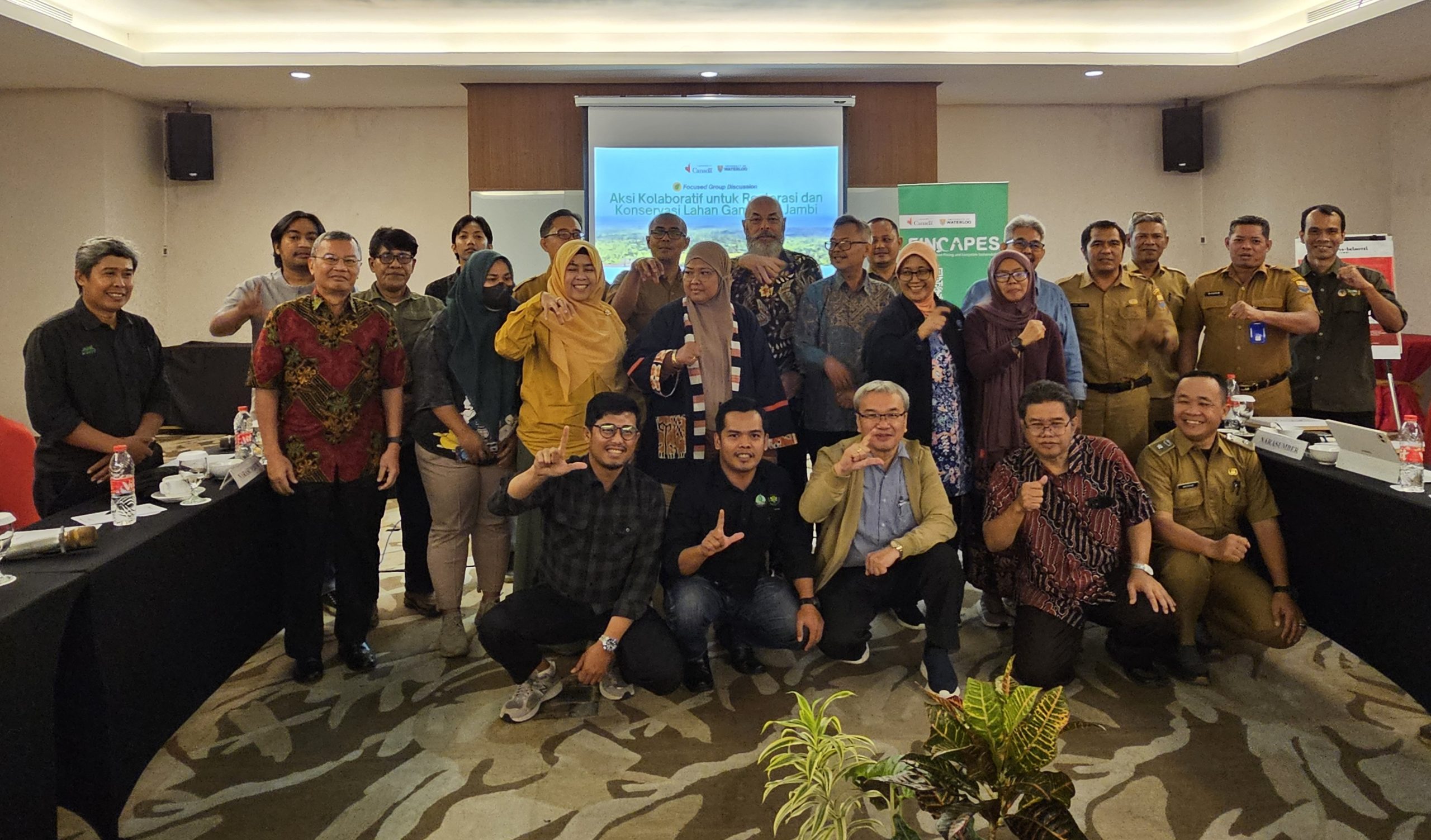
Jambi, 18 February 2025 — Peatland practitioners, government agencies, researchers, NGOs, and community representatives gathered at Swiss-Belhotel Jambi for a multistakeholder Focus Group Discussion (FGD) aimed at strengthening the design and planning of peatland restoration activities in Sungai Gelam Village, Muaro Jambi. The session was part of ongoing efforts to inform the technical design for peat restoration under the FINCAPES–I-CAN initiative.
The Forum brought together 35 participants (8 women, 27 men) from diverse sectors, including the Provincial Forestry Service, BKSDA, KPHP, BPDAS, UNJA, IPB University, NGOs such as Warsi, Green Indonesia, RIMBA Project, WWF, and local community leaders. The discussion focused on extracting lessons learned from past restoration work, identifying on-the-ground challenges, and gathering recommendations to ensure that peatland restoration in Sungai Gelam is both ecologically sound and socially inclusive.
Key Issues Identified
Stakeholders reaffirmed that peatland degradation in Jambi is driven largely by land drainage, especially for oil palm cultivation. As highlighted in the discussions, communities often follow drainage practices used by HTI and HGU concession holders, accelerating ecosystem damage and contributing to peat fires. Limited community understanding of sustainable peat management and the absence of long-term incentives further complicate restoration efforts.
Insights and Proposed Approaches
Participants emphasized the need for strengthened 3R interventions (Rewetting, Revitalization, and Revegetation), supported by business and market analysis to avoid short-lived, project-based outcomes. Comparative studies between oil palm and alternative commodities were encouraged to guide more sustainable livelihood pathways. Several promising peat-compatible crops were highlighted — including coconut, jelutung, eucalyptus, pineapple, and watermelon — although market research will be essential to ensure commercial viability.
The importance of Masyarakat Peduli Api (MPA) was also underscored, with calls to strengthen fire mitigation capacity through training and collaboration with Manggala Agni.
Gender Dynamics and Community Participation
Although land ownership under HKM is largely male-dominated, stakeholders noted that women play significant roles in land management and economic activities, including rubber tapping and areca nut processing. Participants encouraged gender-responsive approaches to ensure women are meaningfully included in restoration decision-making, capacity building, and the development of alternative livelihood models.
Existing Initiatives and Local Momentum
The Forum mapped existing peat-related initiatives in the Sungai Gelam and Air Merah areas, including canal blocking, borehole installation, and revegetation projects conducted by BRGM and the Forestry Service. IPB University also highlighted the establishment of the Center of Excellence for Nature-Based Solutions (I-CAN), which will support ongoing research, innovation, and restoration design. Land preparation in the target sites will continue to avoid heavy machinery to protect peat integrity.
Recommendations and Next Steps
Stakeholders collectively recommended:
- Aligning the restoration design with existing Business Work Plans (RKU).
- Selecting peat-compatible planting patterns based on local ecological data.
- Conducting fauna assessments to inform ecosystem-based restoration.
- Providing technical assistance to farmers from planting through harvesting to ensure program sustainability.
- Strengthening coordination between village leaders, farmer groups, and implementing teams.
The insights gathered from this FGD will directly inform the technical design for peatland restoration in Sungai Gelam, ensuring that the initiative is grounded in community realities, local ecological conditions, and multisector expertise.