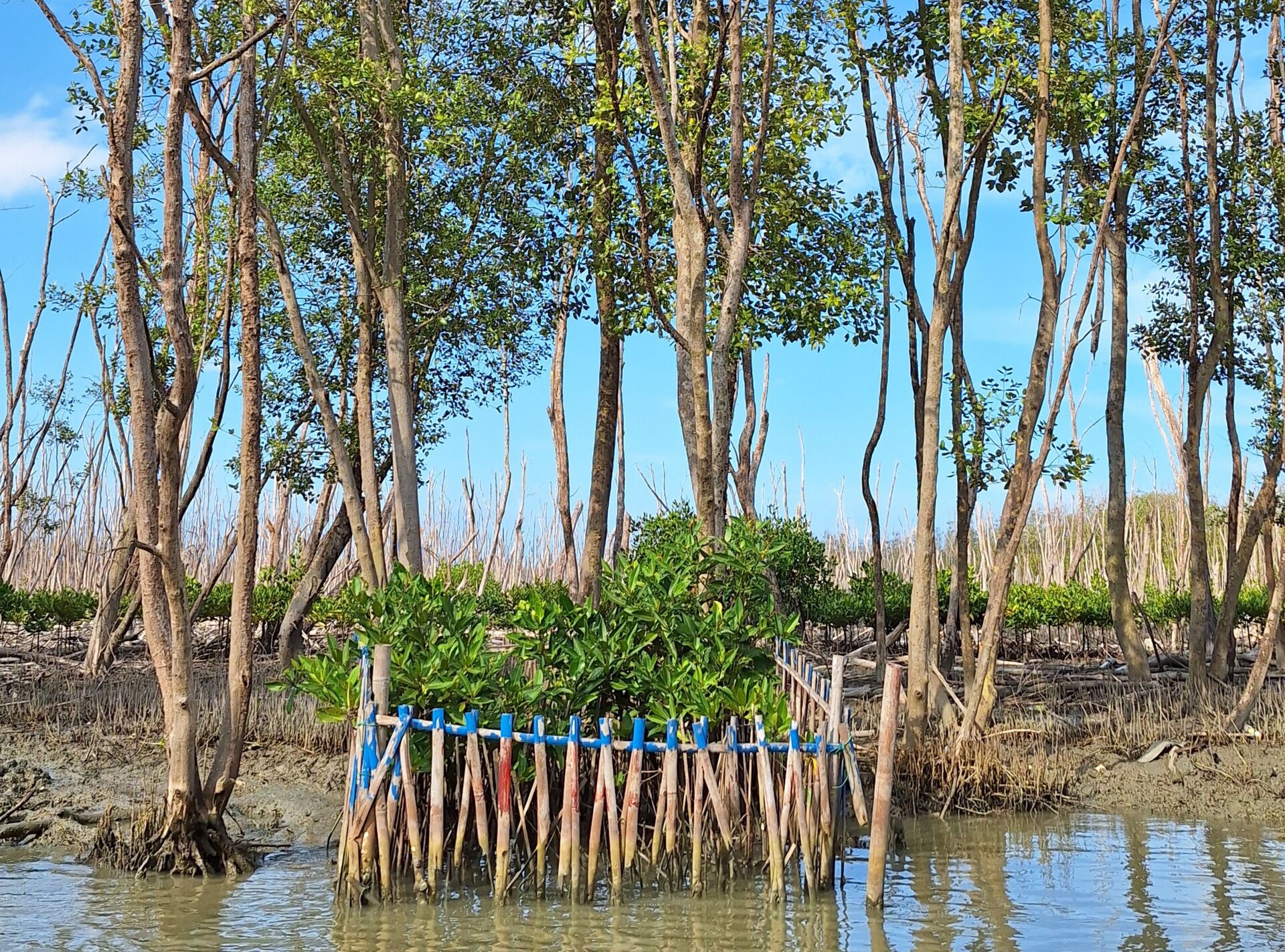
The living laboratory in Purworejo spans 20 hectares within the Muara Sekampung Protected Forest (Register 15), an ecosystem rich in muddy sediments and aquatic life. Here, I-CAN, together with the local forest farmer group KTH Mutiara Hijau, is restoring mangroves while empowering the people who depend on them.
This site is not chosen by chance. Years of study revealed a unique biophysical character: nutrient-rich mudflats, moderately dense mangrove stands, and vibrant benthic life, all essential signs of a system still capable of recovery. Researchers from IPB University and ITERA found that Avicennia marina, a hardy pioneer species, naturally thrives here, while Rhizophora apiculata needs targeted replanting. Together, these species hold the key to rebuilding ecological balance and strengthening the coastline against future threats.
Environmental monitoring paints a hopeful picture. Water temperatures hover around 30°C, with balanced salinity, neutral pH, and stable oxygen levels, all ideal conditions for mangrove growth. Yet challenges remain: the mud runs deep in places, demanding precision in site selection and planting to ensure every seedling takes root.
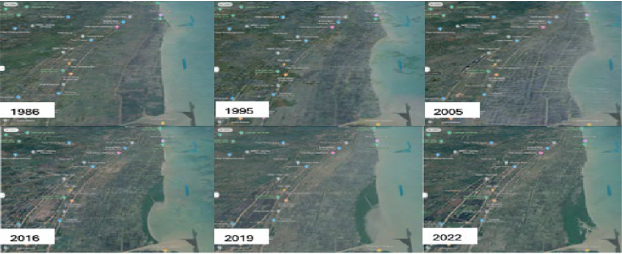
Purworejo’s restoration journey has unfolded over decades, a story of trial, loss, and renewal.This transformation from degradation to regeneration reflects what’s possible when people take stewardship of the ecosystems they depend on, and when science steps in to strengthen their work.
| Year | Milestone | Main Actors |
| 1995 | Large-scale pond conversion stripped the coast of vegetation and biodiversity. | Private investors, local pond owners |
| 2008 | Natural sediment began to return; villagers started spreading mangrove seeds informally. | Residents of Purworejo |
| 2017 | Accretion expanded; structured community planting began. | KTH Mutiara Hijau, local forestry officers |
| 2022 | Land formation reached 371 ha; restoration became multi-stakeholder driven. | KTH Mutiara Hijau, Forestry Agency, NGOs, private sector |
| 2024–2025 | 20-ha restoration and monitoring supported by FINCAPES and I-CAN. | FINCAPES Project, local partners |
Home to 2,747 residents, Purworejo is a developing village where agriculture sustains most families, and where mangroves are both livelihood and legacy. Despite progress in health, education, and infrastructure, challenges in economic opportunities persist, making this living laboratory not just an environmental project, but a social investment.
The collaboration with KTH Mutiara Hijau goes beyond planting trees. It nurtures skills, governance, and leadership through a series of capacity-building programs designed to help the group manage projects, finances, and communication more effectively.
- Organizational and Human Resource Training helps restructure leadership and distribute responsibilities beyond the group’s chairperson.
- Information Management Training strengthens internal communication, starting with a simple WhatsApp group that now connects members and updates progress.
- Financial Management Training introduces transparent budgeting using Excel-based tools, a first step toward formal financial governance.
These may seem like small steps, but they represent a deeper change: empowering communities not just to restore mangroves, but to own and sustain the process for years to come.
Restoration here is also an experiment in precision. The team has implemented five distinct planting designs, a 16-hectare cluster planting area and four 1-hectare experimental plots using 1×1 m, 2×1 m, 2×2 m, and line-cluster spacing. Each pattern is carefully monitored to understand which configuration best supports survival, growth, and natural regeneration.
By turning the landscape into a field laboratory, researchers and local farmers are learning together, adapting techniques as they observe how tides, soils, and species interact. Every seedling planted becomes a data point, a story, and a lesson for future restoration sites across Indonesia.
The I-CAN and FINCAPES teams designed a comprehensive monitoring and evaluation framework to measure both ecological and social progress.
Ecological indicators track survival rates, species composition, soil and water conditions, and biodiversity, from crabs that burrow in the mud to birds that return to nest. Social indicators assess community participation, livelihood gains, and institutional collaboration, ensuring that restoration strengthens not just nature, but the people who depend on it.
By combining these insights, the team aims to build a scientific foundation for adaptive management, ensuring that lessons from Purworejo can inform national strategies and policies for mangrove conservation.
The Purworejo living laboratory brings together a dedicated team:
- Prof. Dr. Ir. Cecep Kusmana, MS – Head of Mangrove Research, IPB University
- Dr. Meti Ekayani, S.Hut., M.Sc. – Socio-Economy Expert, IPB University
- Bayu Winata, S.Hut., M.Si. – Silviculture Technician, IPB University
- Muhammad Ashari Dwiputra, S.Kel., M.Si. – Oceanography Technician, ITERA
- Mindawati Azmi – NbS Project Officer, FINCAPES Project
- Imam Suhardi – Field Coordinator, FINCAPES Project
- Etrin Herabadi Sunjaya, Dimas Hafidhin, and Hajar Nur Asya Ulpah – IPB team members supporting administration, monitoring, and community empowerment.
The Purworejo Living Laboratory is a movement for learning through doing. Every mangrove seedling, every training session, and every dataset collected contributes to a growing understanding of how Nature-based Solutions can deliver both ecological recovery and social transformation.